ROI in Minutes
ROI growth is as fundamental an expectation for owners as salary growth is for employees.
My development (APSDE) supports the highest level of business success by revealing every existing segment, while being fully understandable — because it is the business equivalent of generating every lottery ticket. Instead of promises, a quick test lets anyone verify how closely their own methods can approach the jackpot hidden in the data, so the level of guaranteed ROI becomes estimable.
The test is strongly recommended, because it makes clear how the segments left undiscovered by other methods are not minor gaps — they are forces capable of reshaping the entire market.
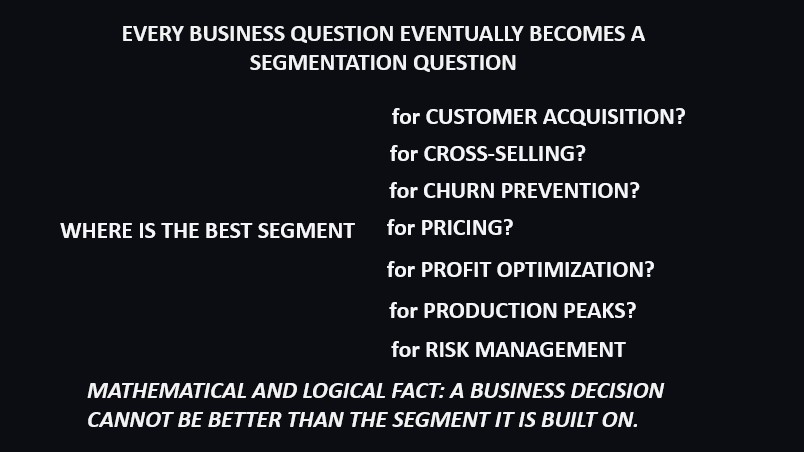
Companies compete aggressively for the best customers and the highest‑performing segments — and their owners are increasingly asking a frustrating question: where is the money we poured into AI projects going, if more than 95% of companies still cannot show any real, correct ROI? Here is the explanation — and the solution that finally makes ROI possible.
Everyone promises to reveal the most valuable segments — yet nobody mentions the uncomfortable truth. I dare to say it: even with just two professional variables — for example one ranging from 20–200 and another from 50–3000 — there are nearly 72 billion possible segments among which we must find the best ones. And logically, “the best” can only be true if every possible segment has been examined — otherwise a massive amount of business potential remains on the table.
With 25 years of experience in combinatorial segment discovery, I developed an ultra‑efficient and truly disruptive algorithm — the All‑Potential Segment Discovery Engine (APSDE) —that generates and evaluates every potential segment — the business equivalent of generating every lottery ticket. It’s just like the lottery: if you give every combination a chance, the business jackpot is unquestionably yours. However, if one of your competitors implements it first, then no one can outperform them.
The fastest way to see the answer is a simple test. Download the small text file with the two variables and a 0/1 business indicator — and name that indicator after the business question that matters most to you: where new customers may surface, where cross‑sell potential emerges, where price‑sensitive clients appear, where high‑margin cases concentrate, where production peaks, where risky cases hide, or whatever truly drives your business.
Safe to download — it's a simple text file, no macros, no executable code.
Download the sample file (test_your_methods_sample.txt) to measure the true power of your existing methods- Every segment must contain at least 600 customers.
- Only segments where your business indicator reaches 15% or above
- or drops to 3% or below — are allowed. Everything in between simply does not belong to the business jackpot league.
APSDE discovered 33 high‑indicator segments and 58 low‑indicator segments from the business jackpot league. Compare these results with the output of your current methods.
The Four Levels of ROI Delivered by APSDE
1) ROI from segment discovery capacity
APSDE uncovers 33 high‑indicator segments. If, for example, your current methods detect only one segment, this single fact already creates a 33× larger ROI opportunity from the very first minute.
2) ROI from time and cost efficiency
APSDE reveals all segments within minutes, without any trial‑and‑error. Traditional model development often requires days or weeks of experimentation. Consequently, the ROI of my work can only exceed the ROI of methods that routinely receive a green light.
3) ROI from multiplying your business results
Let’s calculate ROI together: for example, your goal is customer acquisition and your current methods can detect segments only at around 7.5%, while APSDE reveals segments at 15%. That means your sales team receives 33 segments where 100 visits to potential clients allow you to win 15 new customers — instead of the usual 7–8. Same cost. Twice the new customers. Every owner loves this ROI.
4) ROI from cost avoidance (low‑indicator segments)
The 58 low‑indicator segments show where 100 visits to potential clients would result in 97–100 failures. APSDE prevents burning budget on ineffective segments. And avoiding these failures creates massive ROI. Why focus on low‑probability customers when APSDE continuously produces jackpot‑league segments at a scale no traditional method can match?
For comparing capacities, here are a few additional results: if the lower limit is relaxed (3% → 3.5%), already 949 segments become detectable; if the upper limit decreases (15% → 14.5%), then 270 segments can support better decisions.
And with this approach, any segment — whether generated by your team or by my system — can be verified in seconds with simple Excel filters. Nothing is hidden, nothing is a black box.
Since most companies rely on similar methods, APSDE allows you to estimate — in advance — how much your market share could grow once you enter the business jackpot league. For example, that increase might be +20%, +50%, +100%, or even more. Curious what your number would be. And here is the risk nobody mentions: in a closed market, every gain comes from someone else’s loss — just like a lottery jackpot that is funded by those who trusted their favorite numbers and lost. Widely used methods uncover only a few segments — which is like playing the lottery with only a handful of tickets. This is why the belief that “everyone talks about AI, yet nothing major has changed, so the risk must be small” creates a false sense of safety. In reality, the only reason the risk seems small is that the jackpot has not been taken — yet. And here is how that plays out when someone acts first: we uncovered stronger rules than our competitors and increased market share fourfold within a single year, and one of them lost more than 95% of its best clients as a direct consequence — they had never considered this risk.
If you invest in this project, then on the very first day you will see — in exact numbers — how many times your money multiplies (ROI), and you can be certain that against your competitors, you will always be the one holding every winning ticket.
In every business sector, in every domain, one fact always holds true. Let’s continue the customer‑acquisition example for clarity: If one company converts only 7.5% of its visits into new customers, while another — using APSDE — converts 15%, the first company inevitably disturbs far more potential clients with its visits — and takes far more of their time. This is not fair. The cost of this inefficiency is then pushed into the prices of products and services. Meaning: the actual customers end up paying for the company’s poor targeting performance. This is not fair either.
APSDE changes this.
By revealing high‑quality segments, APSDE ensures that your company disturbs fewer people — which is fair. And lower operational cost leads to lower prices — which is also fair, and significantly increases competitiveness. This is why fairness is not just a moral concept. It is a business advantage. And it is why I would be proud to work with a company where customers matter not only in presentations, but in reality — and where fairness is given to as many customers as possible.
This is why ROI is also a fairness metric: even a seemingly strong increase — for example, +20% more new customers — means little if the cost behind it explodes. Fairness requires efficiency, not just growth.
Fairness matters everywhere — especially in AI projects:
Typical AI project flow:
presentation → trust us → pay us → your data is not good → pay more → “this time it’s really going to deliver” → ROI never appears. This is not fair.
APSDE’s flow is fundamentally different:
analyze the downloadable file with your own experts → if APSDE produces better results, schedule the first meeting → agreement → on day one at 9:00 AM you already know your ROI multiplies → the owner receives real, verified ROI. This is fairness.
A significant part of past ROI failures comes from HR practices as well — because in many cases, decisions were made through personal recommendations rather than selecting the person across the entire space who had actually delivered the strongest results for the owners.
Why most companies never see ROI from widely used data science methods — and how the real bottleneck is the unexplored multivariable combinatorial space.
Why Owners Are Becoming Increasingly Impatient With the Lack of ROI